
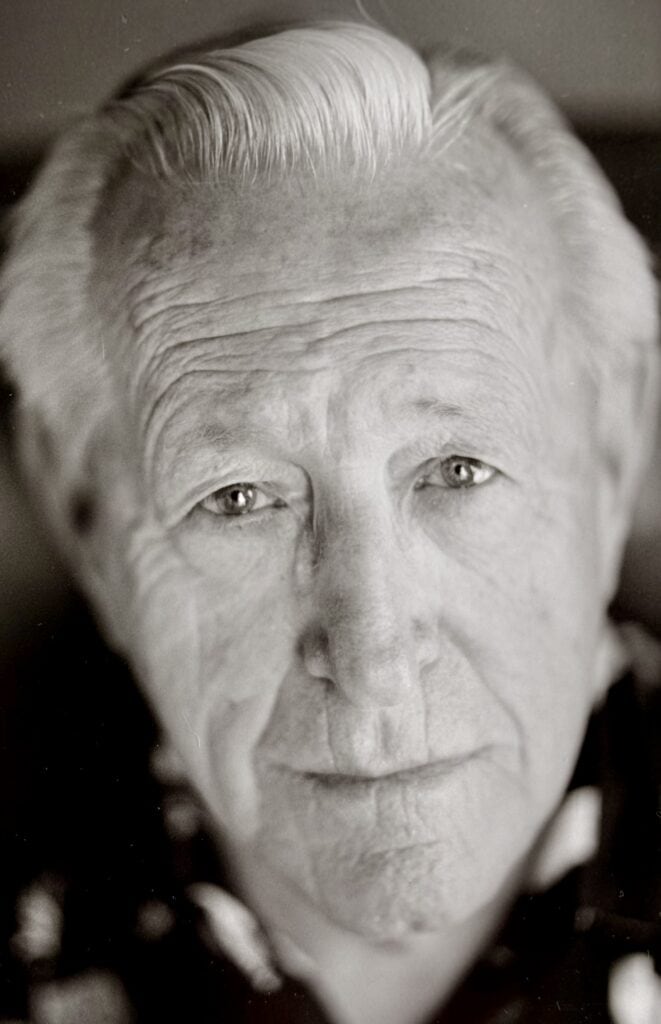
Parked under a tree, Dad and I waited for the Credit Union to open. The cancer had spread everywhere, and at 88 years old, the fight was all but lost. It was time to put things in order: the insurance, the assets, and the bank accounts. Housekeeping. Something one is allowed to do when they know their life is ending.
As the youngest of five brothers, I enjoyed a different relationship with Dad. We were friends. Reminiscing, sharing advice, and relishing the wisdom and freedom that come with age.
Dad thought it was funny to act like a stroke victim. He’d screw up his face, talk out of the side of his mouth, and slur his words.
“Dad! Stop it! That could happen to you!”
He’d bug out his eyes, cock his head, and say, “O riwwey?!”
We laughed. He’d done that stroke-victim routine a thousand times. It never got old.
Wincing from the pain, Dad tried to get comfortable, shifting his weight in the passenger seat. Staring out the window, he said,
“You know, Paul, you really should buy that boat.”
I sighed.
“Yeah, I don’t know. It’s a lot of money, and I’m not sure I’ve got the time.”
“Time?” he said.
Then he turned and looked at me.
“Time?”
He shook his head.
“Buddy, time’s all you’ve got.”
A few weeks later, propped up in a hospital bed in the shag-carpeted guest room of his home, my four brothers and I surrounded him. His death was imminent, but he was conscious, and although the morphine drip eased the pain of cancer tearing through his lungs, Dad wanted to give each of us a few last words of advice. He wanted to talk to us separately. So, being the youngest, I would go last.
His lips were dry, his skin the color of putty. Although sunken and ringed with dark circles, his eyes retained their brilliant steel blue, catching the light, grabbing my attention, and demanding my respect. Reaching for my hands, he pulled me close. It never occurred to me that this would be the last thing he’d say to me. I just thought he’d live forever.
He clawed at my shirt and found the strength to pull me toward his face. As he spoke, he didn’t look at me; he looked through me.
“Paul, you work too much. That’s all you do is work.”
“You built a good business. You are what I could never be. You’re a self-made man.”
“But son, you need a life.”
“Buy a boat.
“Take your share and buy that sailboat.”
Dad died the next day.
For years, I thought his advice was about a sailboat. It wasn’t. The boat was just a prop.
What he was really telling me was that work could not be the entire story of my life.
At the time, I was building my photography business. Like many entrepreneurs, I wore my long hours as a badge of honor. I was always working. Always chasing the next assignment, the next high-profile client, the next opportunity, and the validation that came with them.
Dad understood something I didn’t: making a living and making a life are two different things.
A few months after he passed, I bought the boat.
Ironically, the sailboat eventually became its own business. And as my daughter once said, “Dad, you monetize all your hobbies.”
I don’t think Dad would have expected that, but I think he would have loved the reason behind it.
Today, I watch families, friends, husbands, wives, sons, and daughters spending uninterrupted time together.
They make memories, share stories, laugh, and live.
Sometimes I wonder what Dad would think if he could see Riviera. He’d probably find something wrong with my docking technique. He’d definitely complain about the price of diesel.
And sooner or later, he’d screw up his face, talk out of the side of his mouth, and do that ridiculous stroke-victim routine one more time.
I’d tell him to stop.
He wouldn’t.
We’d laugh.
This Father’s Day, I’d give just about anything to hear him say, “O riwwey?!” one more time.
Instead, I hear something else.
“Buddy, time’s all you’ve got.”
Fair Winds and Following Seas,
Paul & Victoria